Friday, 6 September 2013

Heading East - Planted Drying Beds

Saturday 31st August - Sunday 1st September

After a day off in Dhaka we headed out to Lakshmipur ("lock-he-pur") on Saturday to look at a planted sludge drying bed they've had up and running for a few months.  Construction started in February (2013) and was completed in March/April.

This is a project supported by DIFID.  They are collecting the sludge from 4 wards, each of around 50,000 households, and the site receives a delivery 2-3 times a week. Households pay 1000tk/ 2m3 (about £8 or $13) for the emptying service, and this goes to the Municipality, who then pay contractors who coordinate sweepers, drivers and the vacutug(s) to do the actual collection.

They expect it will take 8-10 years to fill both drying beds.  They are anticipating being able to dig out the material at any point and use it for fertiliser.

Planted drying bed on the right, discharging wastewater into the polishing pond on the left.
Wastewater drains through the bed, and its sand filter in the base, before going into a polishing pond alongside.  They are testing the effluent for BOD and COD prior to discharging it from the polishing pond into a nearby watercourse.  Apparently the pond fills quickly during the rainy season, and they have to pump it out - it does not 'naturally' drain anywhere.
Sludge being delivered via vacutug - you can see it pouring into the bed on the right in the middle of the photo
 The team have had few challenges in the construction and operation phases - it seems the Municipality understands the need for the facility and its benefits.  The main problem they said they faced was acquiring the land.

The main objective of the facility is to provide environmental protection - collecting sludge that would otherwise be hazardously dumped.  The ability to collect and use fertiliser is an additional benefit, but not the main reason for it's construction.

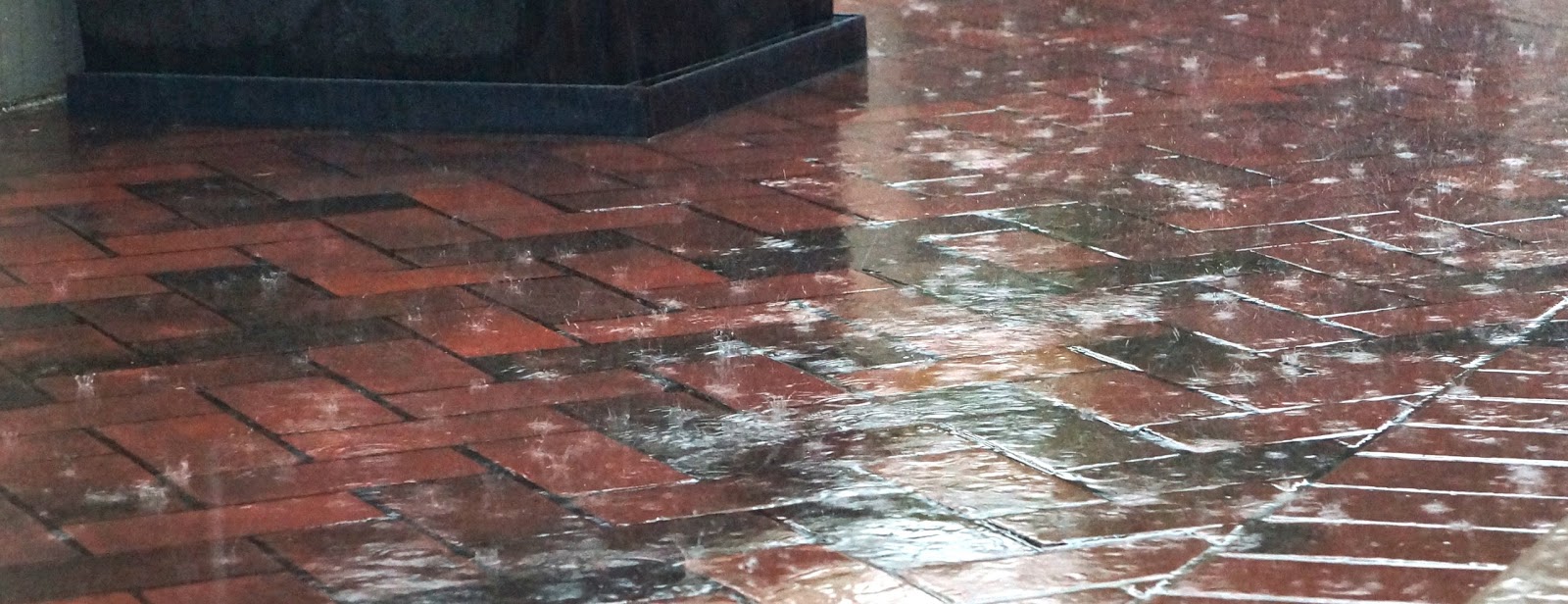
It was really useful to see this solution to large scale sludge management in practice.  Contrary to some of the literature I've read on planted drying beds, there were no noticeable odours or flies, and even the heavy rain did not seem to be causing significant ponding on the surface of the bed.

Close up of the planted drying bed surface

We had a long, long drive back to Dhaka, trying a different route to avoid the centre, and using roads that varied from good to barely-passable.

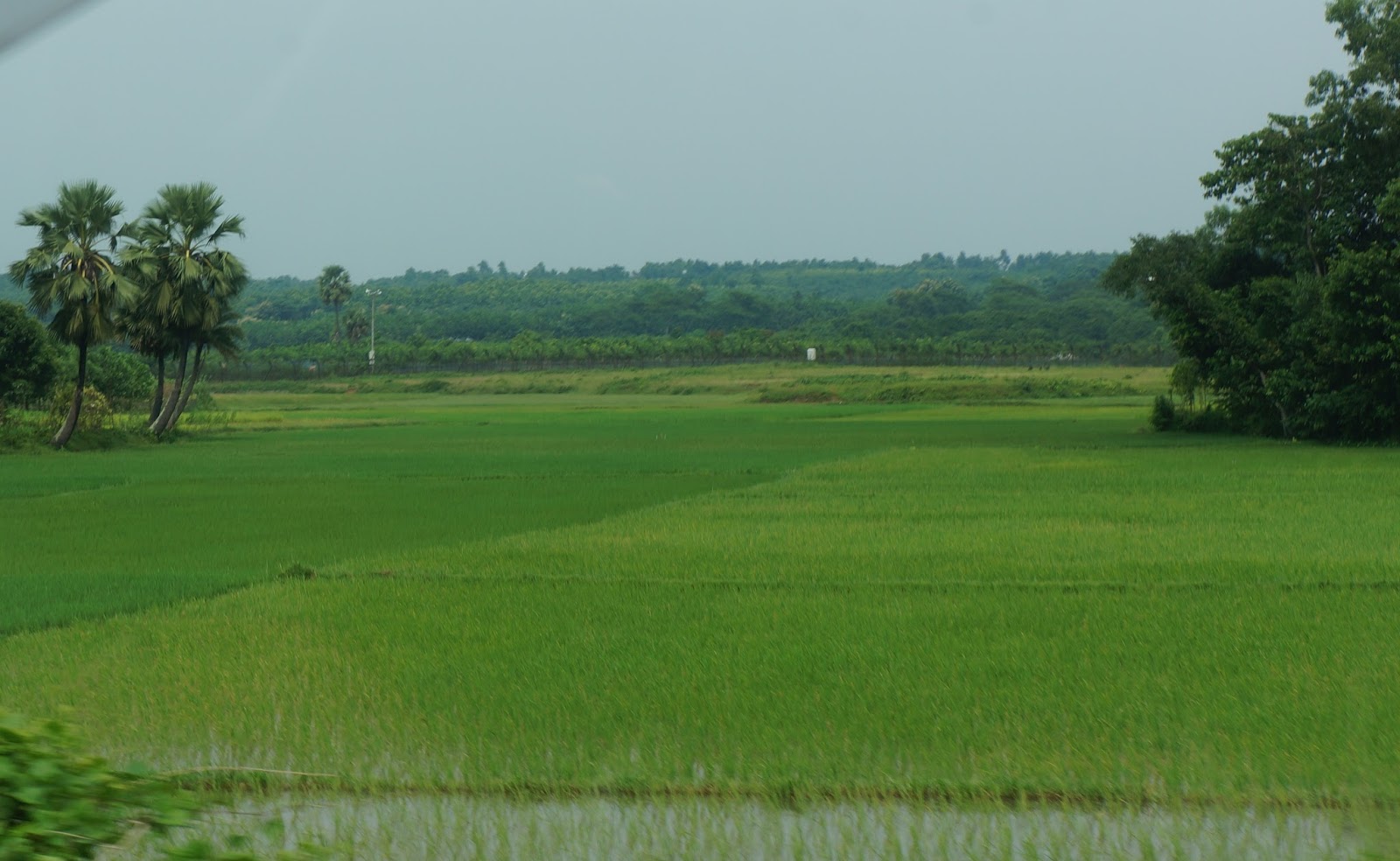
View of the Indian border...and HILLS! (in India...)
Still, we made it by about 9pm; time for a quick check-in, unpack, and repack for our 8am flight to Jessore tomorrow.

View of some of the heavy industry somewhere outside of Dhaka

Sampling, Phase 3

Thursday 29th August

Today we reviewed the site, took samples and delivered them to the icddr,b.

I drew out a plan for the implementation team from Practical Action - we are trying to compare raking vs not raking, alongside a ventilation strategy, so we had to be very explicit.  The beds were labelled A, B and C.  Beds A and C were to be raked daily, and B was not to be touched.  All beds were to be opened at 9am and closed at 5pm each day, for the first 5 days.  This is the drying phase.  As of day 6, they were all to be shut, 24/7.  This is the 'cooking' phase.  This ventilation strategy seemed to work well last time, so it will be interesting to see how it goes during the hot and humid monsoon - I really hope they dry well!

The filled beds - you can just see the blue dot of the silicone enclosure of the temperature sensors in the sludge


We also noticed significant shading of the bed closest the gate from the trees on the edge of the site, so we asked PA to see if they could chop out the tops to prevent them affecting the results.

On another note, I wanted to double check how available they found the polythene (they call it celluloid) they are using for the new roofs.  Apparently it was easy to get in the market in town, as its often used for tablecloths and so on.  This was good to hear - I didn't want it to be an obscure, difficult to source material.

  
Packing the samples and a shot of the almost clear effluent going into the reedbed.

Our samples
So, all in all, nothing too eventful today, but we did pass a lorryload of water buffalo on the way home...


Thursday, 5 September 2013

The Sludge Men Cometh

Wednesday 28th August, 10pm - 3am

After dinner, our first stop was a mosque/ school in Faridpur, with a now disused septic tank (their new latrine block had been completed two or three months earlier).  We caused a lot of interest and many boys stopped by to see what we were doing.

Mosque Collection
 The sweepers who completed the training last time were back, and kitted out in their aprons, masks, gloves and wellies.  Unfortunately, while they normally sleep during the day and work at night, today they had been pressed into service to dig drainage ditches for a nearby community that had been flooded.  This meant they were pretty tired, and I really felt for them.

The Sweeper Team


Collection and loading onto the truck


Overseeing the sludge collection
 We collected about 13 barrels (about 700L), but unfortunately it was quite liquid due to rain soaking through into the tank.  After delivering it to site, we then went on to a school.  This had suffered more than the mosque, and it was just dirty water in the tank.

The truck arrives on site
You can see the different consistencies we have to deal with in the photos below - it varies enormously, barrel to barrel, tank to tank, latrine to latrine.


The waste-trap mesh worked pretty well, although my feeling is that it is too fine - we had someone raking over it continuously to persuade the 'right' stuff to go through.  It did prevent a lot of the plastic detritus from getting into the drying beds though, so that was good.


We end up with quite a big team on site during delivery!


A filled bed
After the first delivery, and abortive trip to the school, we went back to the bus station we visited on our first collection trip.  Here it turned out two ladies (sisters/ mother and daughter) were living in a shack built on top of the septic tank.  We ended up in this strange situation of waking them up at 1:30am, and turning them out of their house, while our sweepers went in and started bucketing out FS from what was essentially the middle of their living room floor. 
Negotiating to bucket poo out of the middle of their house at 1:30am....


Eventually we’d filled the requisite barrels, and we headed over to the exit.  Unfortunately, despite the drivers best attempts at a run-up, the truck got stuck in a giant muddy rut/puddle.  I was keen on using our car to tow it out so we could all finish up and go to bed, but the guys weren’t keen.

Wheelspinning in a bus station
45mins later, at about 2:45am, they’d unloaded enough of the barrels to unweight the truck sufficiently to get it out - with a lot of pushing and shouting.

We ended up with about 700L in each drying bed, and then went to bed ourselves.

Sunday, 1 September 2013

Day One of Phase 3 - Tunnel Vision!

Wednesday 28th August

We traveled down to the site at Faridpur this morning, and as it is a public holiday, the streets were relatively clear.  We made it to the Faridpur Muslim Mission (our overnight hosts) by lunchtime, and had time to freshen up and have a bite to eat before heading over to the site.

Views from the ferry
This is the kind of ferry we were on - classic roll-on/ roll-off type.

This is the Padma River - just after the Ganges and Brahmaputra converge in the middle of the country - and its huge (takes at least 45mins to cross by ferry)

Snacking on guava
It later turned out that we had been lucky to get across so smoothly - one of our colleagues at Practical Action had been delayed for several hours the day before, as one of the ferries had grounded.  This is an increasingly severe problem, as the rivers (all 24,000km of them) in the country are silting up, and dredging is an expensive and time consuming process.

The Faridpur Muslim Mission is an orphanage, vocational training centre and guesthouse, and the rooms are clean and tidy, and the staff kind and helpful, though the electricity supply is somewhat variable.

Faridpur Muslim Mission Guesthouse

Simple but pleasant room


I got to site and had a big smile on my face – the new ‘polytunnel’ roofs are just what we had been thinking of at the outset of the project, although the team here have added some great touches, like zippered closures and velcro tabs to stop the sides blowing out.
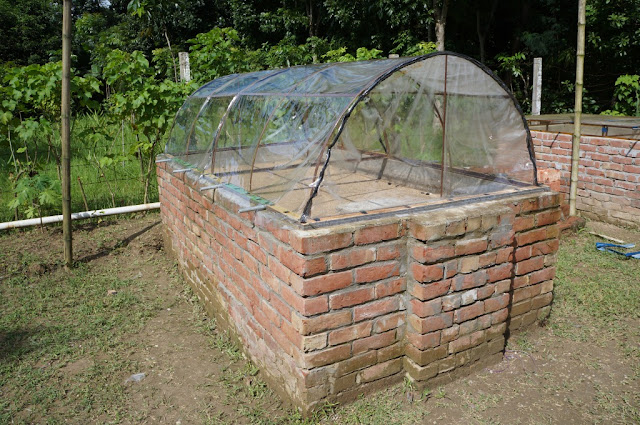
New roofs!

With velcro tabs secured
Without the velcro tabs secured


Practical Action have also created a little demonstration growing bed, where half the soil is mixed with composted sludge from phases 1 and 2, and half is plain.  They’ve planted various crops in these beds, and hope to show the productivity of the earth with its new additive:


Unfortunately the team planted different crops in each quadrant, limiting the amount of direct comparison we could do, but I’ve urged them to repeat the trial with the next set of compost generated, and plant the same crops across the beds, so we can directly see any improved growth.

The reedbed has grown up and flowered, and they’ve put some fish in the polishing pond, and some examples of the Bangladesh national flower.

The reedbed has grown up since my last visit
(plastic) lilies in the polishing pond
Another example of the nice touches that are happening at site are the potted planted along the entrance to the new office.  I’m not saying they wouldn’t have done this had I been male, or had there not been a lady working on the project at Practical Action who thought of it, but….it’s a lovely gesture and does give the place a homely feel.

The Site Office
We noted a couple of lessons in terms of material use - under prolonged sunlight/ heat the polycarbonate sheet of one of our old roofs had become so brittle, that a few weeks earlier someone had put a bottle on top of it and the sheet shattered:


 Similarly the roof we painted back in Phase 1 of tests is now peeling:


As the project progresses, its always a good reminder to see these impacts over the long term (its 10 months since the construction phase started) and consider the sustainability of any design we develop or recommend.  
It also highlights the choice we are so often faced with between cheap/ quick/ short-lifespan vs expensive/ slow/ long-lifespan.

The weather station was at a crazy angle, so we've taken it down, checked it over and repositioned it on the short pole you can see on the right - should also give a better sense of temperatures at ground level.

Repositioning the weather station
Reusing our 'winning' roof from last phase of tests:


On cue, it started raining in the afternoon - you can see the need for roofs!


I also spotted our handyman/ labourer making rope from jute fibres - repeatedly twisting them together until the desired thickness was achieved:


With all the water around, we don't seem to have many mosquitos, but we do have a lot of dragonflies and butterflies flitting around the site.  I managed to get a photo of one with transparent wing patches:


(Apologies for lack of focus on this one - but you can see the wingtip highlighted against the grass)

My next post will be about the sludge delivery.

Tuesday, 27 August 2013

Back in the game...

27th August 2013

So, I'm back in the delta for the last phase of tests, and it's monsoon time.


Big splooshy rain in the afternoon for 1-3 hours, and the kind of humidity that makes you feel a bit woozy and hungover if you're outside too long.


After a stop off with Dr Zahid at the icddr,b today, it's off to site tomorrow, and I'm very excited to see what's been done since I last saw it a few months ago.

It's been a difficult few months for the team here, in terms of progressing the project, what with Ramadan and Eid and various assessments and visits by WaterAid dignitaries, but some steps have been taken. The filter materials have been removed and cleaned - partly to check for the cause of the mysterious blockage in one of the beds last time, and partly to ensure that each test starts on a clean bed, for comparability.  The roof has also been redesigned - I'm particularly keen to see how they've interpreted all the photo's of polytunnels I sent them!   

I'll write a fuller update tomorrow, once I've seen the site.